LoRa Flood Sensor Development Series - Part 2 Schematic Design and Component Selection
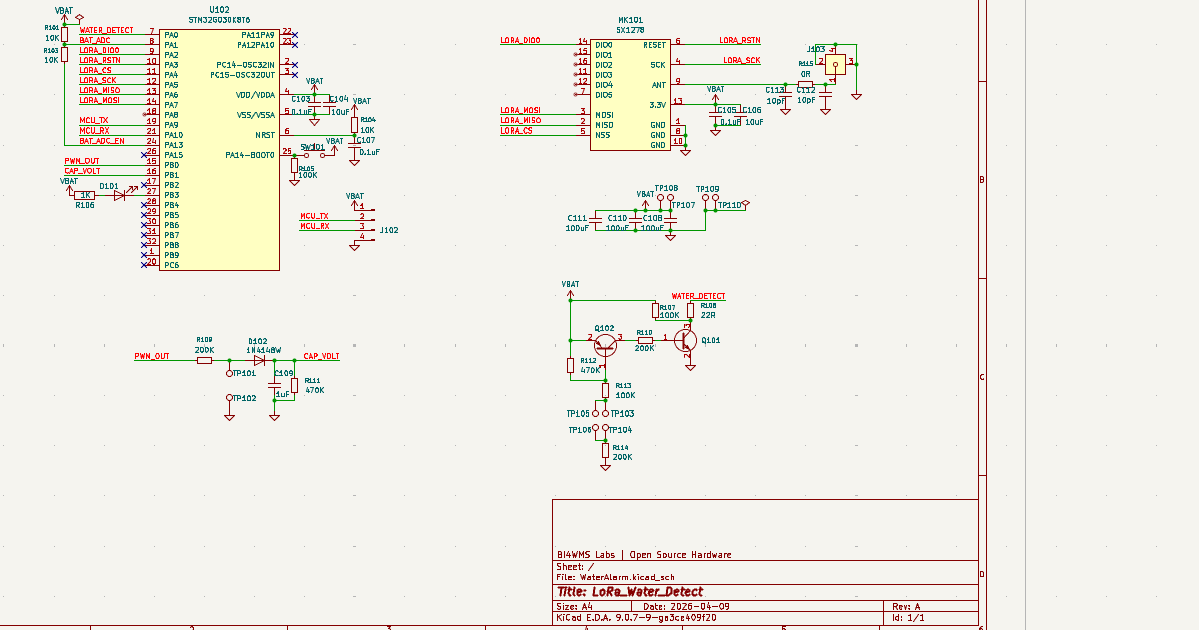
LoRa Flood Sensor Development Series – Complete Schematic Design Guide
Building a reliable, ultra-low-power water leak/immersion detector with LoRa connectivity? This project uses the STM32G030K8T6 MCU and SX1278 LoRa module for excellent Arduino compatibility, long-range transmission, and minimal power consumption.
In this guide, we share the full hardware design using the simplest electrode resistance principle for water detection, plus a reserved capacitive sensing option for future upgrades.
Project Overview
Core Detection Method: Simple electrode resistance sensing (two electrodes shorted by water).
MCU: STM32G030K8T6 (familiar, well-supported, Arduino-friendly).
Wireless: SX1278 LoRa module (better Arduino ecosystem support than LLCC68).
Power: CR2450 coin cell with large bulk capacitors for LoRa transmission peaks.
Programming: UART bootloader (no SWD required during normal use).
MCU Minimum System Schematic
Key Features & Connections
- MCU: STM32G030K8T6
- LoRa Interface: Full SPI connection
- Programming/Debug: UART bootloader + serial debugging (simplifies layout by removing SWD)
- Battery Voltage Monitoring: Sampled only when PA13 is driven low (power-saving strategy)
- Heartbeat LED: PB3 drives a status indicator LED
- Reset Circuit: Simple RC reset network
- BOOT0: Switch for easy bootloader entry during firmware flashing
- Water Detection: PA0 (electrode input, configured as input with internal pull-up)
- Capacitive Sensing Reserve: PB0 and PB1 pre-wired for future capacitive method evaluation
This minimal system keeps the design compact and low-cost while maintaining flexibility.
LoRa RF Module Circuit
We chose the SX1278 over LLCC68 for superior Arduino library support and easier development.
Main Features:
- Standard SPI interface to MCU
- Additional GPIO line connected to MCU for module control (DIO0/DIO1 etc.)
- PI-type matching network on the antenna for optimal RF performance and easy tuning
- Reference design layout followed for maximum range and stability
Water Immersion Detection Circuit (Electrode Resistance Method)
Principle: When water bridges the electrodes, it creates a conductive path that triggers the detection signal.
Circuit Design
- Uses a PNP + NPN transistor combination for efficient switching and low standby current.
- TP = Detection electrodes (two pairs implemented — one on the front and one on the back of the enclosure for better coverage).
- When water is present → Q102 turns on → Q101 turns on → WATER_DETECT signal goes LOW.
- MCU Pin: Configured as input with pull-up enabled. Low level = water detected.
This design is extremely simple, reliable, and consumes almost no power when dry.
Reserved Capacitive Water Detection Circuit (Future Upgrade)
For environments where electrode corrosion or false positives from minerals might be an issue, we pre-reserved a capacitive sensing path.
Principle: Water’s dielectric constant (~80× higher than air) significantly changes the capacitance between two electrodes.
Circuit Details
- TP101 & TP102: Capacitive sensing electrodes (can be PCB traces or custom plates).
- PWM_OUT: MCU-generated PWM signal drives the sensing circuit.
- Peak detector formed by diodes and capacitor converts capacitance change into a DC voltage on CAP_VOLT.
- MCU can read CAP_VOLT via ADC. Significant voltage shift expected when immersed.
This section remains unpopulated by default but gives the hardware future-proofing.
Power Supply Circuit
Battery: CR2450 3V coin cell.
Challenge: LoRa transmission can cause high current peaks that may trigger brown-out resets.
Solution:
- Three 100µF electrolytic capacitors in parallel as energy storage.
- This bulk capacitance stabilizes voltage during TX bursts, ensuring reliable long-range LoRa operation.
Next Steps
PCB layout
Perfect for smart home, basement monitoring, industrial leak detection, or agriculture applications. Simple, cheap, and long-range thanks to LoRa.
Tags: STM32 IoT, LoRa Water Sensor, DIY Leak Detector, Low Power IoT, Water Immersion Sensor, SX1278, Arduino LoRa Project