LoRa Flood Sensor Development Series - Part 1 Water Immersion Sensor System Solution
LoRa Flood Sensor Development Series – Water Immersion Sensor System Solution
Recently, I evaluated a water immersion sensor system solution. Here is a quick summary of the proposed design.
1. User Requirements
Design a wearable water immersion alarm device. The key requirements are as follows:
- The device must be wearable, powered by a coin cell battery, and support standby operation for more than 1 year.
- In a dry environment, the device remains in standby mode. When water is detected, it immediately transmits an RF signal and reports a unique identity code to the platform system.
- The system must support a capacity of 500 devices.
- Communication range must exceed 200 meters.
2. System Solution
With coin cell battery power and a standby time of over 1 year, ultra-low power consumption is the top priority. At the same time, supporting 500 devices makes ordinary RF solutions difficult to implement reliably. We need a protocol stack that supports reliable addressing, collision avoidance, retransmission, and acknowledgments.
After evaluation, the LoRa system solution is the most suitable choice.
- Node Device Side: Use a mature LoRa chipset such as SX1278 + low-power MCU.
- Water Detection: Adopt the proven resistance-based detection method, with special attention to electrode anti-corrosion design.
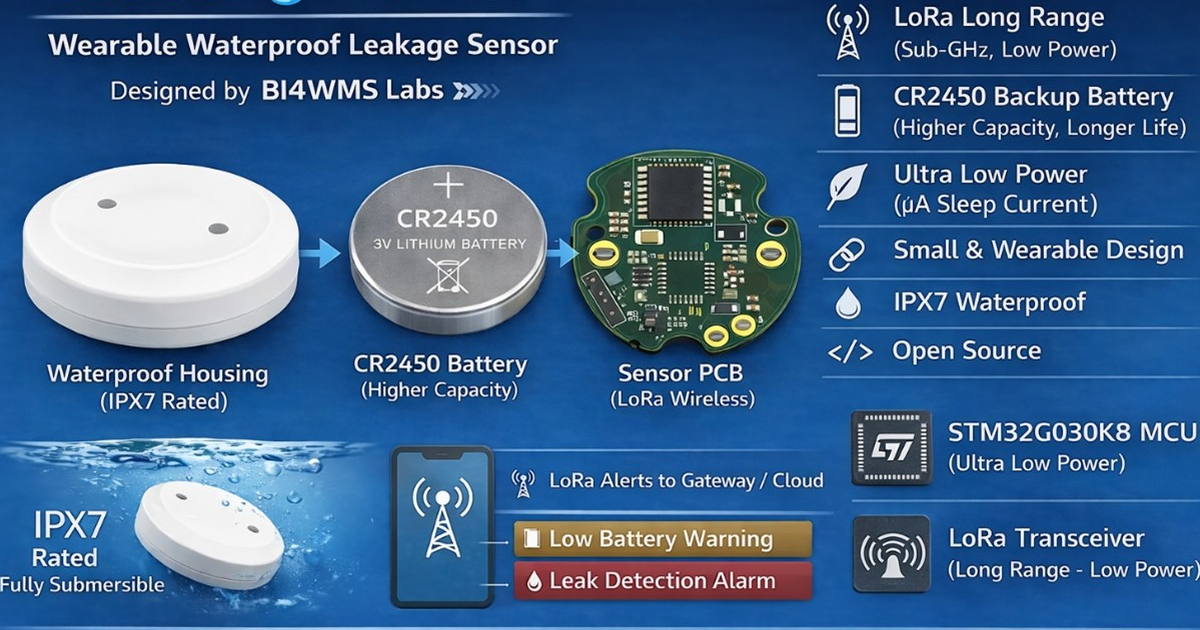
I have become proficient with KiCad recently. After selecting a suitable off-the-shelf enclosure, I completed the PCB layout design to fit inside the shell.
3D PCBA Appearance
I then fed the 3D PCBA images, enclosure photos, and key product information into an AI tool to generate a promotional color flyer for the node device.
System Platform Architecture
The platform adopts a LoRa Gateway + PC Platform solution. The LoRa gateway communicates with the PC system via wired or wireless networks. I also used AI to generate the overall system design block diagram.
Next Article: Schematic design – stay tuned!
Technical Blog Post – Water Immersion Sensor Project