SimpleFOC Integrated Board from Zero to One - Part 1
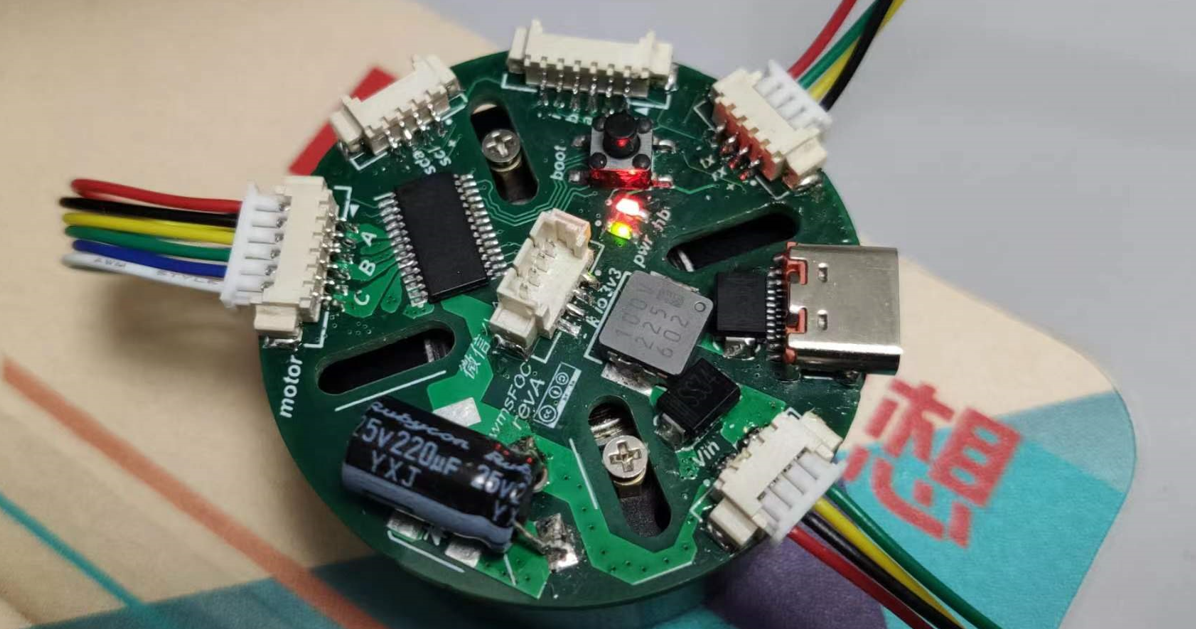
Why Do We Need a Tail-Mounted SimpleFOC Integrated Board?
As the title suggests, this is a from-zero-to-one series covering hands-on learning, design, debugging, and practical insights. The series walks through:
- Hardware design fundamentals
- Software and hardware environment setup
- Getting the motor spinning
- Applying it to real-world projects
This is a record of my journey learning SimpleFOC, aimed at helping beginners quickly understand, design, and build their own motor control boards and applications.
Final Result Preview
Mounted on a 4010 brushless motor
Mounted on a 2204 brushless motor
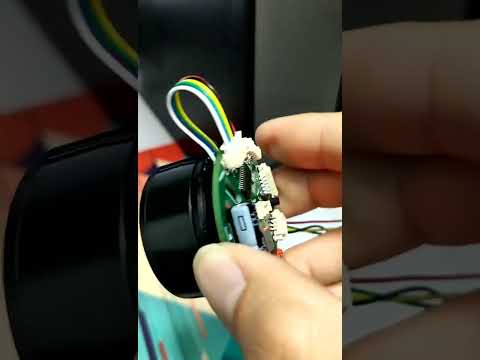
Control demo video
1. What is SimpleFOC?
SimpleFOC (Simple Field Oriented Control) is a popular open-source project that makes it easy to implement Field Oriented Control (FOC) for brushless motors.
Compared to traditional trapezoidal (square wave) control, FOC offers:
- Smoother and quieter operation
- Higher torque output
- Better efficiency
It is widely used in applications such as:
- Robotics
- Gimbals
- Self-balancing vehicles
For many makers, SimpleFOC is often the first step into advanced motor control.
Compared to other open-source FOC platforms like VESC or ODrive, SimpleFOC is more beginner-friendly, mainly because:
- It provides a simple and intuitive Arduino library
- It leverages the rich Arduino ecosystem
- It significantly lowers the barrier to entry
With just basic programming knowledge, users can quickly implement:
- Velocity control
- Position control
- Torque control
2. Limitations of Official SimpleFOC Development Boards
The official SimpleFOC boards (such as the Shield and Mini) are great for learning and prototyping. They are affordable, open-source, and easy to use.
However, when transitioning from experimentation to real-world applications, several issues become apparent:
- Large size and lack of compactness
- Difficult to mount directly on motors, requiring many jumper wires
- Messy wiring, which is prone to loosening and instability
- Closed-loop control is cumbersome, often requiring external encoders and manual alignment
- Low integration, leading to complex assembly and debugging
These limitations can be frustrating, especially for beginners trying to build compact and reliable systems.
3. Why Design a Tail-Mounted SimpleFOC Integrated Board?
To address these pain points, I designed a compact, highly integrated SimpleFOC control board that can be mounted directly on the motor.
This board is specifically created for beginners and makers who want a clean, compact, and practical solution.
Key Features
🔧 Direct Motor Mounting
- Slot-based PCB design
- Compatible with 2204–4010 brushless motors
- Can be mounted directly on the motor base
- Adds almost no extra volume
🧲 Onboard Magnetic Encoder
- Sensor placed at the center of the PCB
- Perfectly aligned with motors using magnetic rings
- For motors without a magnet: simply attach a small magnet to the shaft
- Enables high-precision closed-loop control with minimal setup
🔌 USB Type-C Interface
- Built-in USB-to-serial chip
One Type-C cable for:
- Firmware upload
- Parameter tuning
- Real-time debugging
🔗 Flexible Expansion
- Independent UART control
- External I2C sensors
- Support for ABZ encoders
⚡ Complete Hardware Integration
- Built-in current sensing resistors
- DRV8313 motor driver onboard
- Supports current loop control
- Suitable for small to medium power motors
🧠 Main Controller
- STM32F103CBT6 microcontroller
- Rich peripherals and widely supported
📐 Physical Specs
- 42mm × 42mm circular PCB
- 4-layer PCB design
🌐 Fully Open Source
- Hardware and software fully open
Includes:
- Altium design files
- Manufacturing (PCBA) files
- Arduino-based reference firmware
4. Summary
With this integrated board, you no longer need to worry about:
- Complex wiring
- Mounting difficulties
- Tedious setup procedures
Simply:
- Mount the board
- Attach a magnet (if needed)
- Connect power
…and you can immediately start working with SimpleFOC.
This makes it especially suitable for anyone looking to build compact, clean, and high-performance motor control systems.
What’s Next?
In the next article, we’ll dive deep into the hardware design details of this board, including:
- Schematic analysis
- Component selection
- PCB layout design
Stay tuned!